The President’s Ballot Question vs. A Citizen’s Defaced Ballot: Double Standards and Systemic Flaws
A recent incident at an early voting station has sparked nationwide public outrage.
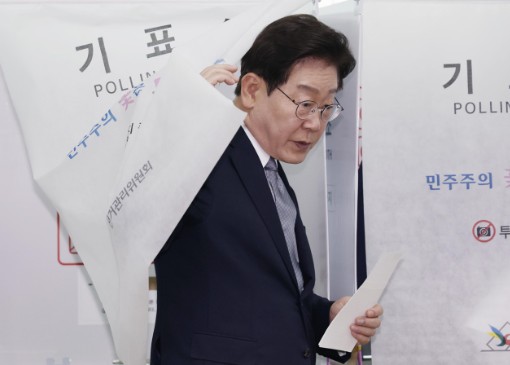
The controversy involves two drastically different outcomes: President Lee Jae-myung walked out of a polling booth mid-vote to ask an election official about the validity of his ballot, while a 60-year-old voter in Bucheon tore his ballot in frustration after being blocked from re-entering the booth to fill out a missed section. He was subsequently booked without detention for violating the Public Official Election Act.
Internet communities and news comment sections erupted instantly. “Why is the president cleared of any wrongdoing for walking around with his ballot, while an ordinary citizen becomes a criminal just for trying to fix a genuine mistake?” many asked. Let’s dissect this sharp contrast in legal application and the inherent contradictions of the National Election Commission (NEC) system to see what a truly fair and logical resolution should have been.
1. Lack of Expertise Among Field Staff and Administrative Convenience
The root cause of this incident lies in a chronic structural issue within South Korea’s election management system. Despite elections being the cornerstone of democracy, the front lines of polling stations are manned not by election law experts, but by low-ranking local government public servants and one-day temporary workers.
These individuals receive only a few hours of superficial training the day before the election. They fundamentally lack the professional qualification to flexibly handle unique voter circumstances while protecting voter rights.
Consequently, when a problem arises, a defensive mechanism kicks in to avoid personal accountability. Staff resort to rigid, bureaucratic control strictly by the book. This lack of administrative flexibility is precisely what escalated an ordinary citizen’s simple mistake into a legal violation.
2. The Blatant Logical Contradiction of the “Booth Exit” Rule
The NEC manual strictly states: “A voter who leaves the polling booth cannot re-enter under any circumstances.” Applying this rule to both cases reveals a massive logical contradiction in the NEC’s enforcement.
- A Razor-Sharp Rule for the Ordinary Citizen
The 60-year-old man stepped out of the booth, realizing too late that he had left the superintendent of education ballot blank. Even though he kept his ballots inside an envelope and pleaded that it was a simple mistake, the NEC blocked him, citing risks of election fraud (such as ballot swapping). They applied a rigid standard: the moment you step out, you have officially “left,” and your process is terminated. - A Rule That Melted Away for the President
Now, look at the President’s actions. The President explicitly walked out of the curtained polling booth holding his ballot to ask about a faint ink stamp. Because both his body and his ballot left the designated voting space, this was a clear violation of the booth boundaries. Yet, the NEC bent the rules, interpreting his action not as “leaving” but as a “temporary inquiry.”
Despite both individuals stepping outside the booth with their ballots, the ordinary citizen’s action was treated as a dangerous threat to election security, while the supreme leader’s action was excused as a legitimate inquiry. This is exactly why the public is furious over “elastic standards” and a perceived “rules for thee but not for me” system.
3. What Would Have Been a Fair and Lawful Resolution?
Based on the core democratic principles of equity and ballot secrecy, the NEC should have maintained a firm yet flexible approach for both parties as follows:
First, the President’s ballot should have been declared “invalid” according to the law.
Article 167 of the Public Official Election Act states that “any disclosed ballot shall be invalid.” Even if the specific vote was not fully visible, exposing a ballot to a public space surrounded by press cameras, bright studio lighting, and onlookers severely compromises the principle of secret voting. Since an ordinary citizen would have faced immediate intervention, declaring the President’s ballot invalid on the spot would have been the only way to ensure equality before the law.
Second, the 60-year-old voter should have been granted a “re-issuance” under the field manager’s discretion.
A malicious fraudster looking to rig an election would manipulate ballots secretly behind the curtain—they would not cause a scene outside the booth asking to go back in. It was commonsensically clear that this was an honest oversight.
Rather than rigidly blocking the path and provoking a confrontation, the NEC should have invalidated and securely disposed of his unmarked ballot in the presence of a manager, re-issued a fresh ballot, and guided him back to vote. A rigid bureaucracy effectively turned an innocent mistake by an everyday citizen into a criminal offense.
Epilogue: Generous to Power, Severe to the Public
Ultimately, this incident highlights a bitter reality in our legal enforcement: exposing the supreme leader’s bizarre blunder as a mere mishap, while hammering down on a regular citizen’s honest mistake. It is the disappointing byproduct of unqualified temporary staff hiding behind rigid protocols for administrative ease.
How do you view this situation where the NEC, an institution that must uphold the highest standard of fairness, has damaged its own public trust?
- Do you believe the NEC’s lenient judgment toward the President was fair?
- Do you think the NEC should have offered a flexible remedy, such as re-issuing a ballot, to the 60-year-old citizen?
- What reforms do you think are necessary for the NEC to establish a standard manual that applies equally to everyone, regardless of status or power? Share your sharp insights in the comments below!
답글 남기기